Study Guide
Prova pratico valutativa per psicologi - deontologia ed etica
Preview
Page 1 of 30
Sample · 5/30
Click to enlarge Page 2 · locked
Click to enlarge Pages 4–11 · locked
Click to enlarge Pages 13–21 · locked
Click to enlarge Pages 23–26 · locked
Click to enlarge
Continued
25 more pages
Locked · Full 30-page document
About this document
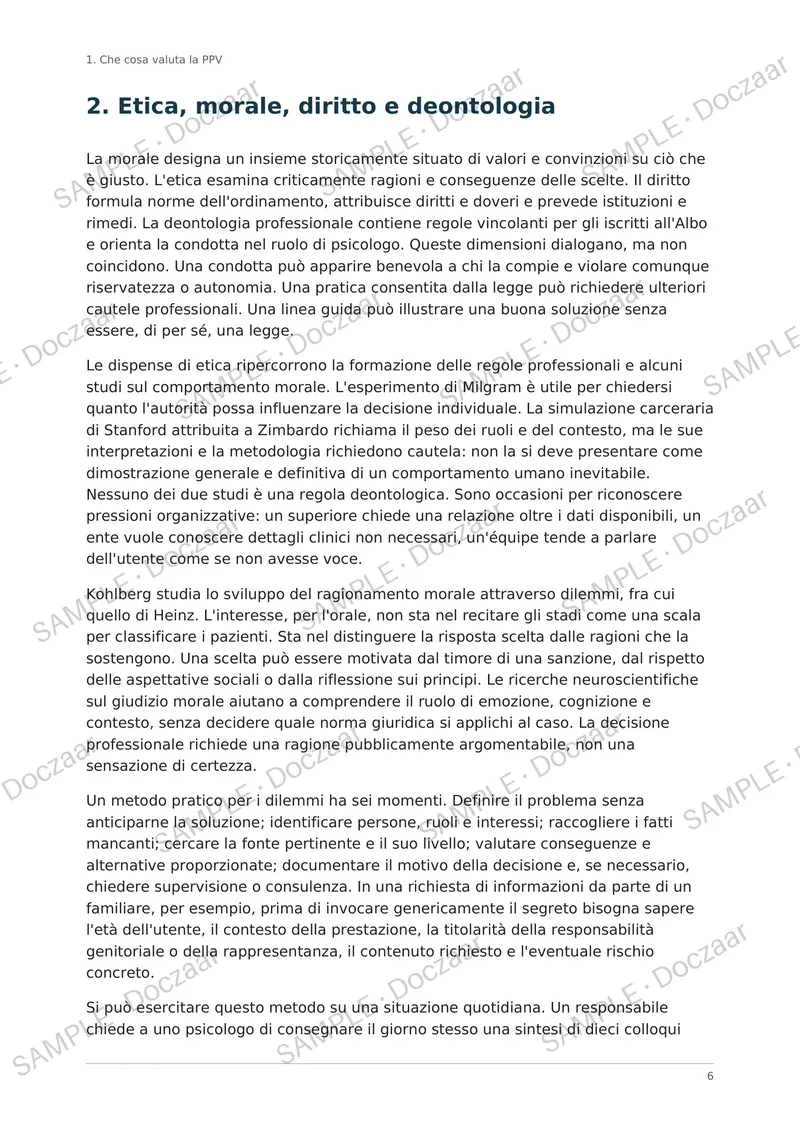
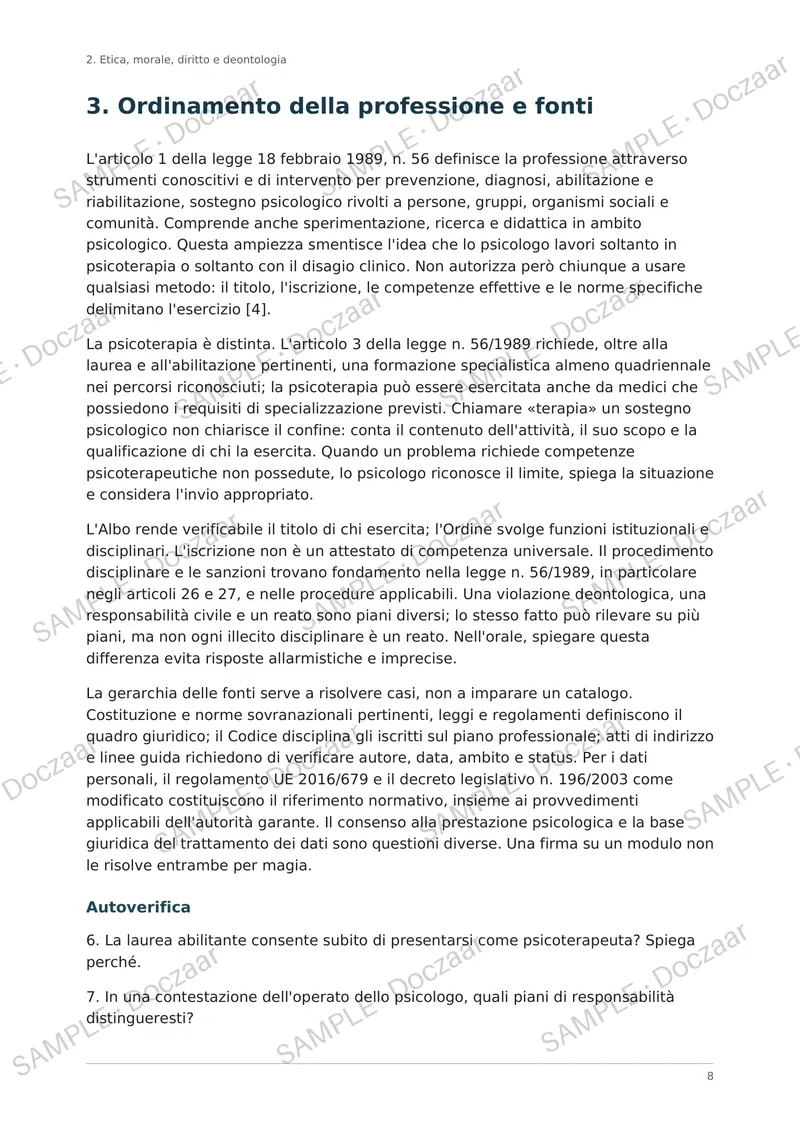
The document provides an in-depth exploration of ethics, morality, law, and professional deontology, particularly in the context of psychology. It clarifies that while morality consists of historically situated values and beliefs about what is right, ethics critically examines the reasons and consequences of choices. Law formulates norms, assigns rights and duties, and envisages institutions and remedies, whereas professional deontology contains binding rules that guide psychologists' conduct. These dimensions interconnect but do not coincide, meaning a well-intentioned action might still breach confidentiality or autonomy, and legal compliance may require additional professional caution.
The document reviews ethical guidelines, referencing studies like Milgram's experiment on authority's influence on individual decisions and Zimbardo's Stanford prison experiment, which highlights the impact of roles and context. However, caution is advised in presenting these studies as definitive proof of human behavior. Kohlberg’s research on moral reasoning through dilemmas, such as Heinz’s, emphasizes understanding the reasoning behind choices rather than categorizing patients. Neuroscientific research on moral judgment aids in understanding the roles of emotion, cognition, and context, suggesting that professional decisions require publicly reasoned arguments.
A practical method for addressing dilemmas involves six steps: defining the problem, identifying involved parties and interests, gathering missing facts, seeking relevant sources, evaluating consequences, and documenting decision reasons. The document also elucidates the initial mandate, information, and consent in psychological practice, highlighting the importance of clear, comprehensible information about services, their aims, modes, and confidentiality limits. It distinguishes between consent for intervention and data processing, underscoring the necessity of real understanding over mere signature.
Reviews
No reviews yet.
Be the first — reviews come from verified buyers.