Study Guide
Reading Visual Art Unit 1: Visual Literacy
Preview
Page 1 of 6
Sample · 2/6
Click to enlarge Pages 2–5 · locked
Click to enlarge
Not shown
4 more pages
Locked · Full 6-page document
About this document
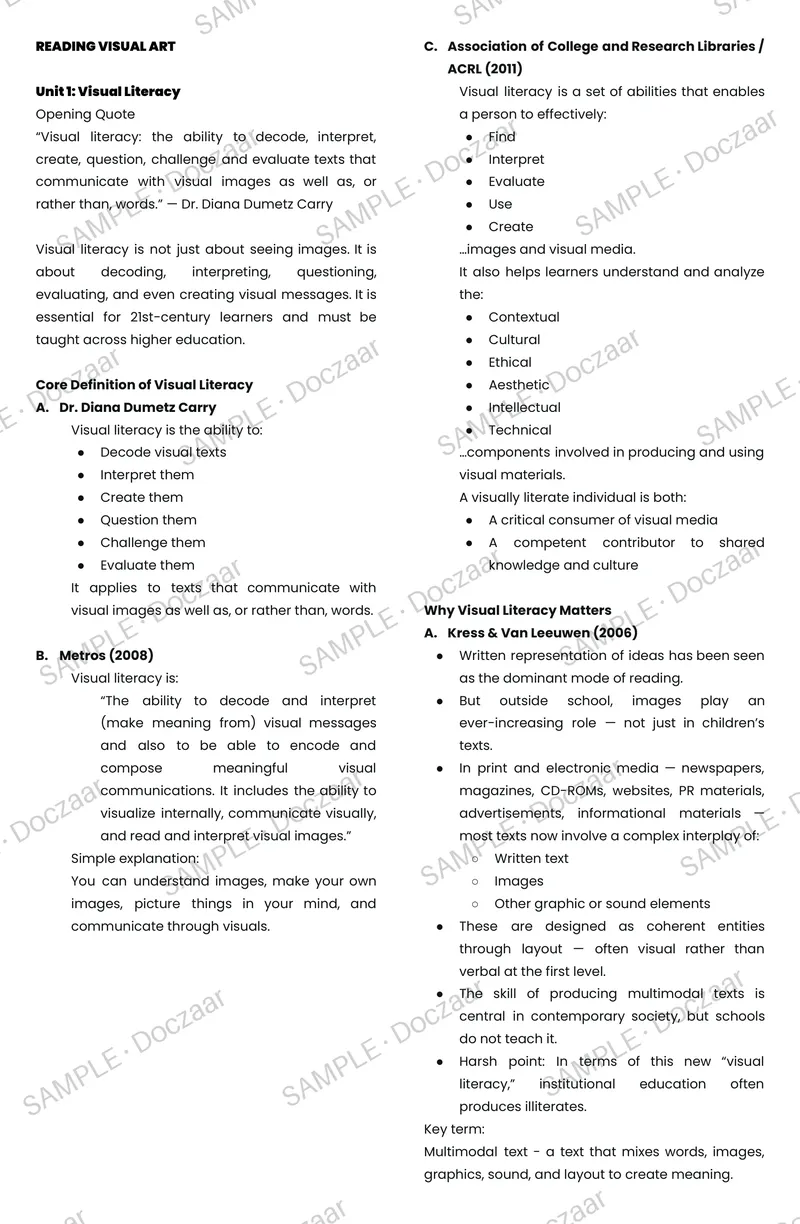
In the document "Reading Visual Art," Unit 1: Visual Literacy, explores the concept of visual literacy and its significance in contemporary education, especially for 21st-century learners. Visual literacy is defined as the ability to decode, interpret, create, question, challenge, and evaluate visual texts, which is essential in an era where images play a dominant role in communication.
This unit draws on insights from experts like Dr. Diana Dumetz Carry and the Association of College and Research Libraries (ACRL), emphasizing the importance of understanding and analyzing the contextual, cultural, ethical, aesthetic, intellectual, and technical components of visual media. The document highlights how visual literacy goes beyond merely viewing images; it involves critical thinking and the ability to create and communicate through visuals effectively.
The discussion further delves into why visual literacy matters, referencing Kress & Van Leeuwen's assertion that while traditional literacy focuses on written representation, the modern world increasingly relies on multimodal texts that integrate written text, images, graphics, and sound. This shift necessitates new educational approaches to avoid producing visually illiterate individuals.
The document also covers the impact of the "Touch" generation and rapidly evolving technology on visual literacy. It stresses the need for students to develop critical thinking skills to navigate the visual information that shapes their world, influencing their decisions and perceptions. Additionally, it underscores the importance of incorporating visual literacy across higher education, as students are expected to engage with and produce visual media in their academic work.
Reviews
No reviews yet.
Be the first — reviews come from verified buyers.