Exam Elaborations
BARKLEY PRE AND POST Chamberlain NEWEST TEST EXAM 100 COMPREHENSIVE QUESTIONS /FREQUENTLY MOST TESTED QUESTIONS AND VE
Preview
Page 1 of 38
Sample · 6/38
Click to enlarge Pages 2–5 · locked
Click to enlarge Pages 7–9 · locked
Click to enlarge Pages 11–20 · locked
Click to enlarge Pages 22–25 · locked
Click to enlarge Pages 27–31 · locked
Click to enlarge
Continued
32 more pages
Locked · Full 38-page document
About this document
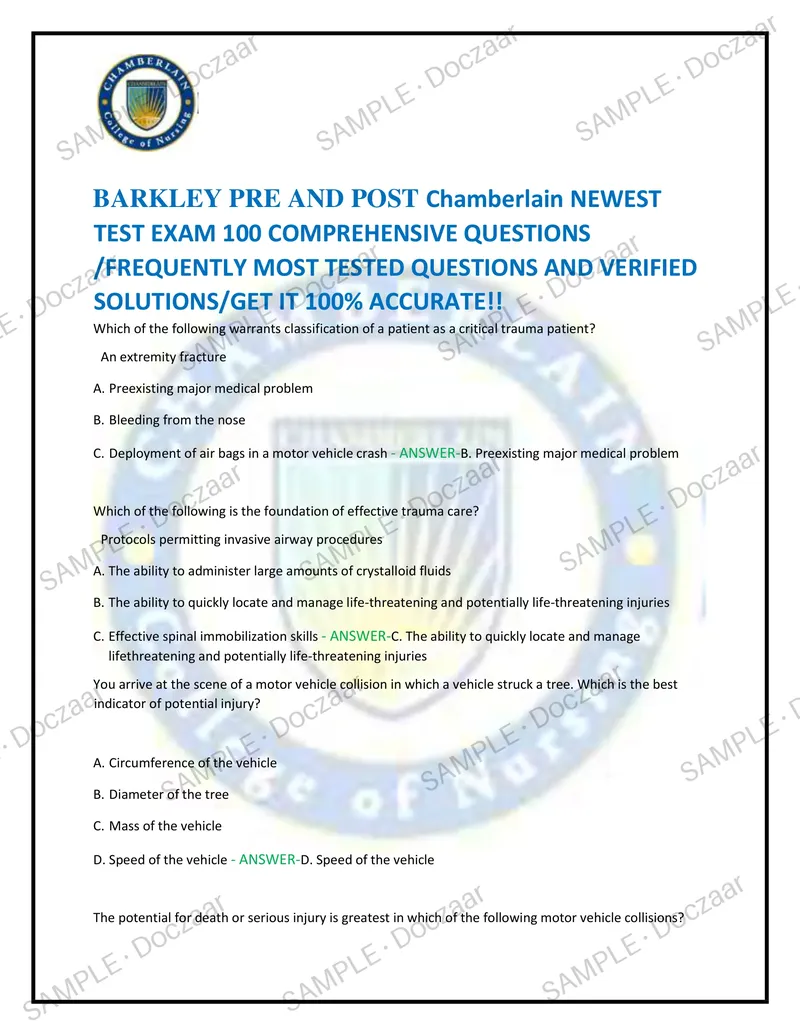
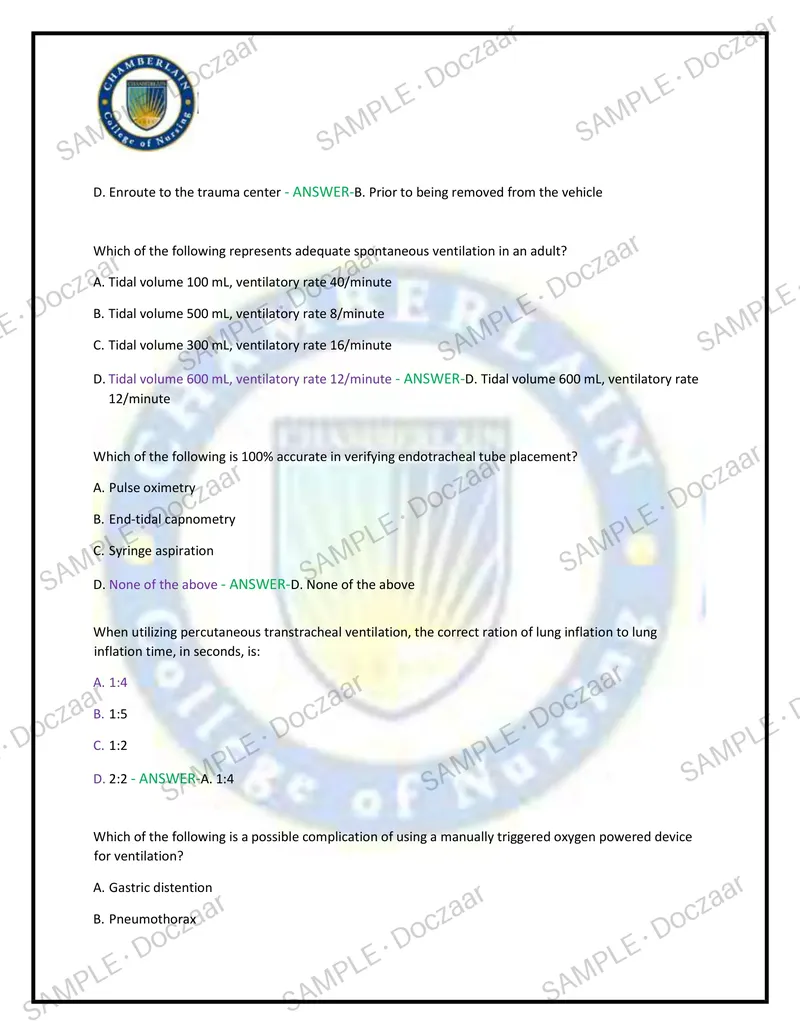
The document titled "Barkley Pre and Post Chamberlain Newest Test Exam" is a comprehensive study guide consisting of 100 frequently tested questions and verified solutions for trauma care and emergency medical services. This resource is designed to help students and medical professionals prepare for exams with confidence by providing 100% accurate solutions to the most commonly asked questions in trauma assessment and management.
Key topics covered include the identification and classification of critical trauma patients, foundation principles of effective trauma care, and indicators of potential injury in various scenarios. For instance, students will learn that a preexisting major medical problem is a crucial factor in classifying a patient as a critical trauma patient. The material also emphasizes the importance of quickly locating and managing life-threatening injuries as a foundation of effective trauma care.
The guide provides insights into the mechanisms and assessment findings for different injuries, such as hemothorax resulting from a blunt chest injury and the implications of speed in motor vehicle collisions. It also covers the physiological impacts of trauma, such as delayed death due to inadequate initial resuscitation and the consequences of abdominal compression injuries.
Furthermore, the document discusses the role of trauma centers, specifically the designation of a Level I trauma center as the leading resource for comprehensive trauma services in a region. The resource is also designed to clarify when spinal immobilization is necessary, aiding in the clinical decision-making process.
This study guide serves as an essential tool for students and healthcare professionals seeking to enhance their understanding of trauma care, ensuring preparedness for real-world medical emergencies and examinations.
Reviews
No reviews yet.
Be the first — reviews come from verified buyers.
Related documents
NR 302 exam 3 NEWEST TEST EXAM 180 COMPREHENSIVE QUESTIONS /FREQUENTLY MOST TESTED QUESTIONS AND VERIFIED SOLUTIONS/GE
Walden University · Nursing and midwifery
41 pagesUndergraduate
NR 565 - advanced pharmacology midterm – Chamberlain NEWEST TEST EXAM 100 COMPREHENSIVE QUESTIONS /FREQUENTLY MOST TES
Walden University · Nursing and midwifery
14 pagesUndergraduate
NR565 Week 5 DM & Thyroid Meds NEWEST 2026/2027 ACTUAL EXAM 80 QUESTIONS AND CORRECT (VERIFIED ANSWERS) COVERING RECEN
Walden University · Nursing and midwifery
19 pagesUndergraduate
NHCO Phlebotomy Exam 2026/2027 TEST EXAM 100 COMPREHENSIVE QUESTIONS /FREQUENTLY MOST TESTED QUESTIONS AND VERIFIED SO
Walden University · Nursing and midwifery
24 pagesUndergraduate
NCCT - Patient Intake and Care Exam 2026/2027 TEST EXAM 100 COMPREHENSIVE QUESTIONS /FREQUENTLY MOST TESTED QUESTIONS
Walden University · Nursing and midwifery
21 pagesUndergraduate
NR 509 FINAL NEWEST 2026/2027 ACTUAL EXAM 130 QUESTIONS AND CORRECT (VERIFIED ANSWERS) COVERING RECENT AND MOST TESTED
Walden University · Nursing and midwifery
33 pagesUndergraduate
NR 509 Midterm NEWEST 2026/2027 ACTUAL EXAM 130 QUESTIONS AND CORRECT (VERIFIED ANSWERS) COVERING RECENT AND MOST TEST
Walden University · Nursing and midwifery
36 pagesUndergraduate
CMSRN NEWEST 2026/2027 ACTUAL EXAM 80 QUESTIONS AND CORRECT (VERIFIED ANSWERS) COVERING RECENT AND MOST TESTED QUESTIO
Walden University · Nursing and midwifery
18 pagesUndergraduate